LocalProspects vs Apify
Apify is flexible scraping infrastructure. LocalProspects is a finished local prospecting workflow with search, business emails, owner names, phone intelligence, and AI enrichment.

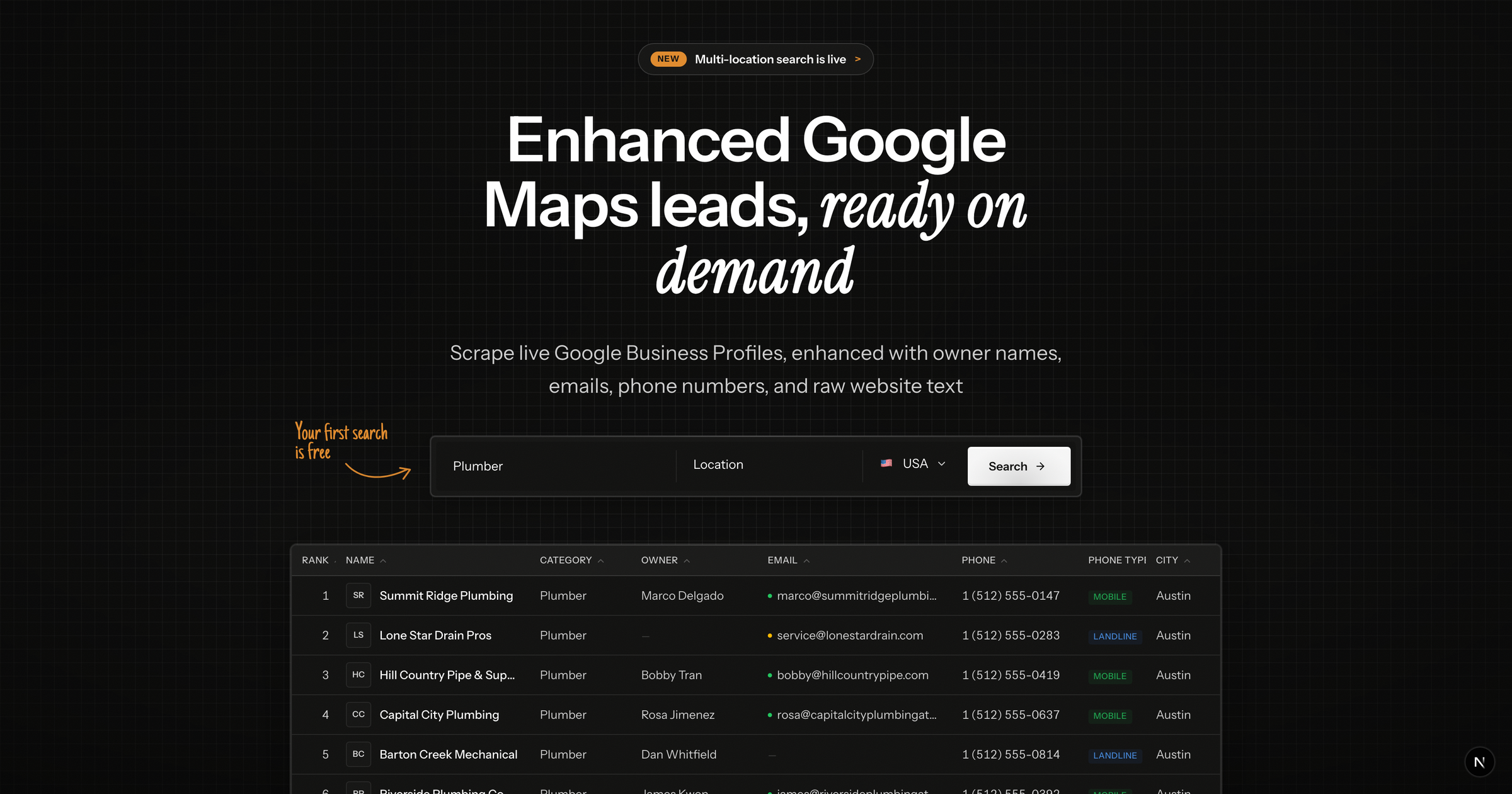
Table of contents
The short version
Apify is not one scraper. It is a scraping and automation platform.
That is its strength. It is also the reason the comparison is different.
If you are technical, Apify lets you pick actors, run them on a schedule, connect APIs, transform outputs, and build custom automation. If you are an agency or local B2B seller trying to get outreach-ready leads, that flexibility can become extra work.
LocalProspects is narrower on purpose: search local businesses, enrich them, organize contact data, and export a prospect list.
What Apify is best at
Apify makes sense when you want:
- a developer-oriented scraping platform
- access to many actors
- custom scraping workflows
- pay-per-event pricing
- API-driven runs
- data extraction beyond Google Maps
- infrastructure you can compose into your own system
For Google Maps specifically, Apify's help docs describe pay-per-event pricing: a base Google Maps charge of $4 per 1,000 places, plus events such as actor start, filters, additional details, contact details, reviews, and images.
That is useful if you know exactly what you want to scrape and how you want to process it.
Where Apify gets more complicated
For local lead generation, a Google Maps actor is only the first step.
You still need to decide:
- which actor to use
- whether it scrapes contact details
- whether it visits websites
- how to normalize fields
- how to clean email outputs
- how to flag role-based addresses
- how to classify phone types
- how to extract owner names
- how to generate personalization context
- how to export the final schema
Technical teams may want that control.
Most lead gen teams do not.
Where LocalProspects fits
LocalProspects gives you the opinionated workflow:
- Search a niche and city.
- Pull local businesses.
- Crawl websites.
- Extract emails, phones, pages, tech, services, socials, and summaries.
- Organize and classify contact fields.
- Export a lead list that is ready for filtering and outreach.
You are not picking actors or building a pipeline. You are getting the enriched result.
When Apify is the better choice
Choose Apify if:
- you are technical
- you need a broad scraping platform
- you want to automate many websites, not just local leads
- you already have email discovery and enrichment logic
- you care more about workflow flexibility than an opinionated lead schema
Apify is infrastructure.
When LocalProspects is the better choice
Choose LocalProspects if:
- your end goal is local outreach
- you want business emails in the same result
- you want owner names, services, phone type, and website context
- you do not want to chain actors and clean schemas
- you want a tool an AI agent can use with predictable fields
LocalProspects is a finished prospecting workflow.
Bottom line
Apify is more flexible.
LocalProspects is more direct.
If you want to build your own local lead pipeline, Apify is a good platform. If you want the pipeline already built for local business prospecting, LocalProspects is the better fit.
Sources: Apify Google Maps Scraper pricing note, LocalProspects API docs.
Where LocalProspects wins
- No actor selection, chaining, or schema normalization required
- Public emails and role/free-provider flags included in the prospecting output
- Owner names, phone type, phone carrier, services, and AI summaries in one dataset
- Built for local outreach rather than general web automation
- Cleaner path for non-technical agencies and AI-agent lead workflows
Where Apify wins
- More flexible if you need custom scraping infrastructure
- Huge actor marketplace for many websites and workflows
- Pay-per-event model can be efficient for variable technical workloads
- Better fit for engineering teams that want to compose their own pipeline
- Supports broader automation use cases outside local lead generation
FAQ
Is LocalProspects a replacement for Apify?
It depends on the job. Apify can still make sense for raw scraping or data extraction workflows. LocalProspects is built for local prospecting, where the useful output is a cleaner list with contact and outreach context.
When should I use Apify instead?
Use it when you mainly need raw place data, custom scraping infrastructure, or a dataset that your own pipeline will enrich later.
When should I use LocalProspects instead?
Use LocalProspects when you want search, website crawling, business emails, owner signals, phone intelligence, and outreach-ready export fields in one workflow.
Does LocalProspects include Google Maps-style business data?
Yes. LocalProspects starts with local business search data, then adds enrichment layers like website context, emails, phone type, tech stack, services, and summary fields.